


Patrocinado
Developing a Parts-Savvy Maintenance Team for Your Grove Crane Fleet
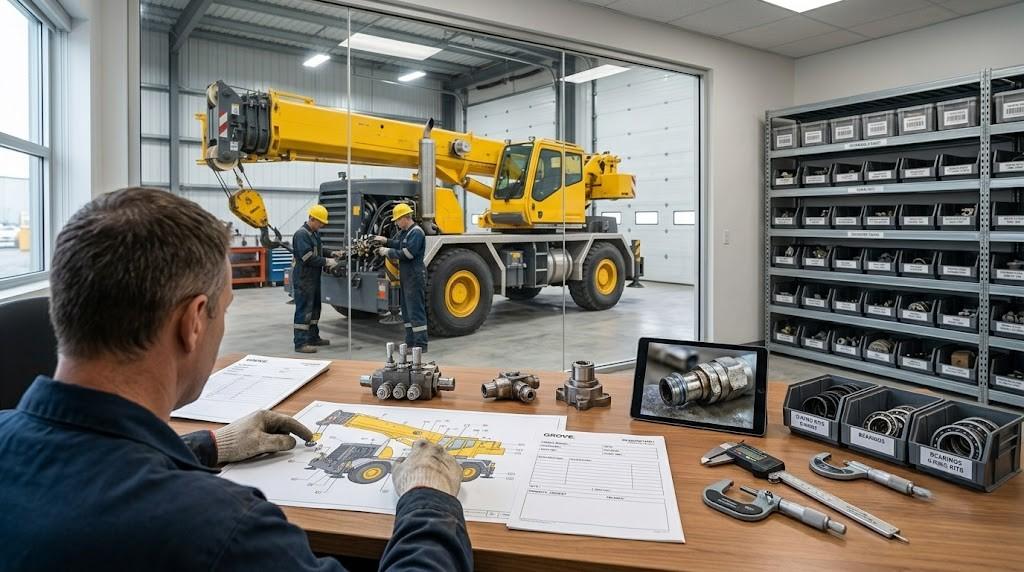
Imagine a crane sitting idle on a construction site while your team waits for a shipment that turns out to contain the wrong component. The clock is running, the contractor is frustrated, and the part needs to be returned and reordered. That scenario plays out in maintenance shops across the industry, and the cause is almost always a gap in training rather than a gap in motivation.
Your technicians are skilled at diagnosing problems and performing repairs. What they often lack is the systematic knowledge required to identify a component precisely and place an order that arrives correct the first time. Closing that gap requires a deliberate training approach, and the steps below outline exactly how to do it.
Build Understanding by Starting at the Machine
Effective training begins with direct observation. Before your team ever opens a parts manual, they need to understand the machine in front of them as a complete, functioning system.
Take the crew to a crane in your yard. Start at one end and move through every major system. Point out the hydraulic power unit and explain how pressurized fluid reaches the directional control valves. Trace the lines to the boom cylinders, the winch motor, and the swing drive. Then examine the electrical harness, noting the major control modules and junction blocks. Finish at the boom structure itself, showing how sections are pinned and telescoped.
This foundational exercise transforms how technicians interact with the catalog afterward. A mechanic who has physically observed the relationship between the main hydraulic pump and the boom hoist circuit will search for Grove crane parts in the correct assembly group immediately, rather than scrolling through pages of unrelated systems hoping to stumble onto the right reference.
Develop Catalog Skills Through Structured Instruction
Parts manuals are detailed technical documents that reward careful study but punish casual browsing. Your team needs explicit instruction in how to navigate them efficiently and accurately.
Gather the group and open the catalog for a specific crane in your fleet. Start with the most basic but most important skill: confirming you have the correct manual for the correct machine. Show them the model and serial number plates on the physical unit, then walk through the catalog's identification page to verify the match. Stress that two cranes from the same product line can have significantly different internal configurations.
Next, teach the catalog's organizational logic. Demonstrate how to use the table of contents to locate an assembly group. Open an exploded-view illustration and show how each numbered callout connects to a line in the parts list. Dwell on the critical distinction between an assembly number and a component-level number.
That distinction prevents costly errors. Ordering a complete hydraulic manifold when the repair only calls for a single internal seal wastes both money and time while leaving the actual problem unresolved.
Create Hands-On Practice Sessions
Paper-based learning establishes a foundation, but physical interaction with real components is where identification skills truly develop. Your team needs regular shop-floor exercises that connect catalog pages to tangible hardware.
Gather a collection of used or failed Grove crane parts from your salvage inventory. A hydraulic fitting, a section of boom pin, an electrical solenoid, and a segment of flexible hose each present useful identification challenges. Arrange them on a workbench and have each technician work through the catalog to identify every item.
Instruct them on where identification markings typically appear — stamped numbers on machined surfaces, cast digits on iron components, and tags attached to flexible lines. Make clear that grease, corrosion, and years of hard use often make these marks difficult or impossible to read. When that happens, the fallback approach involves measuring physical dimensions with calipers and cross-referencing those measurements against catalog data.
For a particularly effective exercise, hand someone a hydraulic cylinder removed from a retired crane. Ask them to locate the correct seal repair kit in the catalog without any initial help. Let them navigate the pages independently for several minutes before stepping in. That moment of independent problem-solving is where lasting knowledge takes root.
Replace Informal Ordering with a Formal System
Knowing which part is needed matters only if the subsequent order is accurate. A structured, documented ordering process eliminates the most frustrating and expensive mistakes in the procurement chain.
Design a standardized requisition form that every parts request must follow. Each submission should capture the crane model, machine serial number, the exact catalog part number, a written description, and the quantity required. No field should ever be treated as optional.
Prohibit informal ordering entirely. Verbal requests and vague notes passed to the purchasing desk should never result in a shipment. Every submission to a crane parts supplier must contain catalog-verified details that allow the vendor to fulfill the request without guesswork or back-and-forth clarification.
Implement a two-stage verification before any order is transmitted. The technician who identified the part checks each number against the catalog a second time. A supervisor then reviews the completed form before it leaves the shop. This simple checkpoint catches the majority of transcription errors before they generate costly return cycles.
Prepare Your Team for Professional Vendor Communication
Your team will interact regularly with a crane parts supplier, and the effectiveness of those interactions directly influences delivery timelines and order accuracy. Treat vendor communication as a teachable skill rather than leaving it to chance.
Start with introductions. Connect your lead technicians with the vendor's primary account contact. Establishing that relationship early removes friction and accelerates resolution when urgent needs arise.
Before any vendor interaction, the technician should prepare the machine serial number, the verified component number, and the catalog page where they located the reference. If any uncertainty remains about which part is correct, sending a clear photograph of the physical item alongside the catalog excerpt typically resolves the question quickly.
Help your team understand the vendor's operating environment. Suppliers handle hundreds of requests daily. Well-organized and complete submissions move through their system more efficiently. If a part is needed by a specific deadline, communicate that timeline explicitly rather than assuming expedited shipping will happen automatically.
Handle Discontinued and Updated Parts with Confidence
Product lines evolve over many years. Some machines in your fleet may need parts that the current catalog no longer lists under their original references. Your team needs the knowledge and composure to handle these situations effectively.
Train technicians to recognize superseded part numbers. When a reference comes back as unavailable, it most likely means a newer version has replaced it. The updated component may look different from the manual's illustration while delivering improved performance.
Some revisions require minor modifications to the older machine for proper installation. These situations should be treated as routine challenges rather than crises. Confidence in navigating superseded parts is a hallmark of an experienced maintenance professional.
When a component has been fully discontinued with no direct equivalent available, a knowledgeable crane parts supplier may offer aftermarket solutions or have the capability to remanufacture the original part. Teach your team to explore these options before concluding that a machine has reached the end of its serviceable life. That approach preserves assets and keeps productive equipment in the field.
Validate Skills Through Realistic Training Scenarios
Classroom learning builds knowledge, but only applied exercises reveal whether that knowledge holds up under the kind of pressure a real breakdown creates. Regular simulations are essential to any effective training program.
Present the team with a plausible scenario. A crane on a remote job site has suffered a hydraulic failure in the boom extension circuit. The machine is completely inoperable. Give each technician a defined time window to diagnose the probable cause, locate the correct Grove crane parts in the catalog, and prepare a complete purchase requisition with all necessary details.
Debrief the exercise as a group. Check whether they identified the correct component, included every required field on the form, addressed delivery timing, and inquired about core charges for any rebuildable assemblies.
These drills accomplish two critical objectives simultaneously. They expose gaps in individual knowledge and process discipline before those gaps cause real problems on a job site. And they build the kind of calm, methodical confidence that allows technicians to perform accurately even when genuine equipment failure demands immediate action.
Maintain Easy Access to Reference Materials
Even the best training program loses effectiveness when technicians cannot reach the materials they were taught to use. Parts catalogs need to be available wherever work is being performed.
Keep current printed copies in the shop, the maintenance office, and any field service vehicles. Distribute digital versions through a shared network folder or load them onto tablets and phones for portable access.
When a mechanic is working beneath a crane in difficult field conditions, the ability to access the correct manual page on a handheld device can save hours of downtime. Organize your digital files by model and serial number so that navigating to the right reference takes moments rather than minutes.
Treat Every Error as a Learning Event
Proficiency in parts identification and ordering develops through consistent practice and thoughtful correction over time. A single training session establishes a foundation, but only ongoing reinforcement builds lasting expertise.
When an incorrect part arrives, investigate the process rather than assigning blame. Trace the sequence from initial identification through order submission. Was the catalog page misinterpreted? Was a number mistyped? Did the vendor receive incomplete information? Identify the root cause and correct the underlying workflow.
Share those findings with the broader team. Each correction refines the collective knowledge base and strengthens the accuracy of every technician involved.
When your maintenance crew can consistently identify and order Grove crane parts without hesitation, the impact on your operation is immediate. Cranes spend more time in productive service, maintenance budgets are allocated more efficiently, and your technicians develop the professional confidence that transforms a reactive maintenance shop into a proactive, self-reliant operation.
Patrocinado
Categorias
- Core Faith & Theology
- Christian Lifestyle & Practical Living
- Community & Church Life
- Creative & Inspirational Content
- Cultural Engagement & Outreach
- Practical Ministry & Resources
- Niche & Specialized Blogs
- Seasonal & Themed Content
- Interactive & Community-Driven Content
- Humor & Relatable Content
- Outro
Leia Mais
" According to the latest report published by Data Bridge Market Research, the Electron Microscope Market The global electron microscope market size was valued at USD 3.40 billion in 2024 and is expected to reach USD 5.46 billion by 2032, at a CAGR of 6.10% during the forecast period Electron Microscope Market report is a great option to achieve current...

The Cricket T-20 World Cup has evolved into one of the most exciting global sporting spectacles, bringing together fast-paced action, dramatic finishes, and worldwide fan engagement. Organized by the International Cricket Council, the tournament showcases the best cricketing talent and unites millions of viewers across continents. But beyond the thrilling sixes and nail-biting...

According to the latest report published by Data Bridge Market Research, the Feed Yeast Market CAGR Value The feed yeast market is expected to witness market growth at a rate of 9.95% in the forecast period of 2022 to 2029. The comprehensive Feed Yeast Market report offers a thorough overview of product specification, technology, product type and production. By...
According to the latest report published by Data Bridge Market Research, the Irradiation Apparatus Market CAGR Value The global irradiation apparatus market size was valued at USD 8.34 billion in 2025 and is expected to reach USD 13.04 billion by 2033, at a CAGR of 5.75% during the forecast period Today’s businesses are more inclined towards the market research report...
" According to the latest report published by Data Bridge Market Research, the Green Chelates/Natural Chelating Agents Market The global green chelatesnatural chelating agents market size was valued at USD 2.87 billion in 2025 and is expected to reach USD 4.24 billion by 2033, at a CAGR of 5.00% during the forecast periodThe market growth is largely fuelled by the rising demand for...
