


Sponsor
When to Remove Your Kobelco Crane Wire Rope from Service
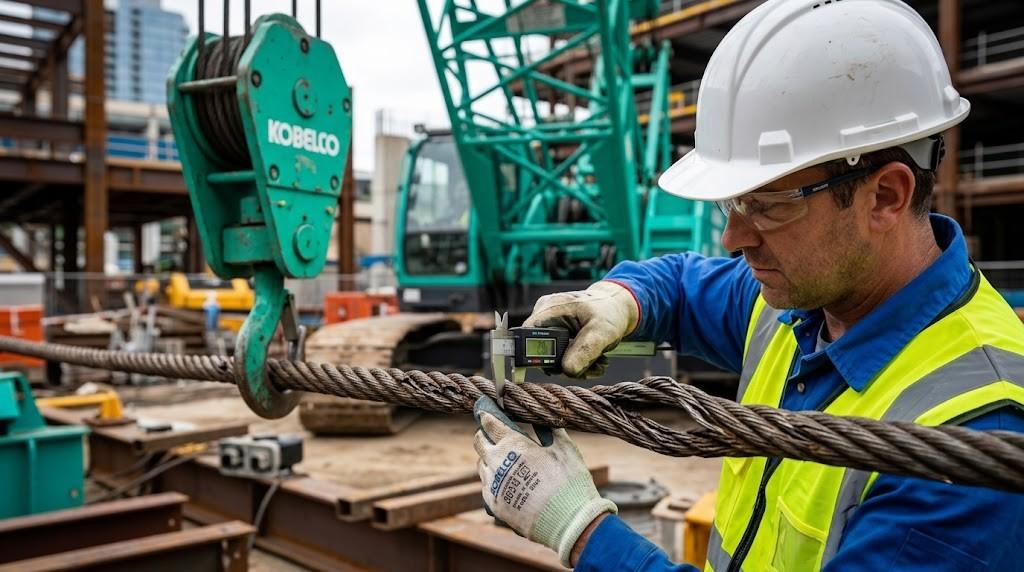
The hoist line on a Kobelco crane bears the full weight of every load lifted. This single component connects the machine to the payload, making it the most critical element in the lifting system. When wire rope fails, the load falls without warning. The consequences range from equipment damage to serious injury.
Wire rope does not maintain its original strength indefinitely. Normal operations subject the rope to bending, tension, abrasion, and environmental exposure. These factors gradually erode its load-carrying capacity. Recognizing the warning signs of impending failure allows operators to retire ropes before they break.
1. Visible Wire Fractures
This warning sign stands out as the most obvious to the naked eye. As the rope cycles over sheaves, the outer strands endure repeated flexing. Eventually, individual wire filaments fatigue and snap. These broken ends project from the rope surface and can cut anyone handling the line.
The number of fractures determines the appropriate response. A few isolated breaks may not be critical. However, inspectors must evaluate a specific length called a lay, which is the distance for one strand to spiral completely around the core. Industry practice dictates replacement when six broken wires appear within that lay length. Additionally, three breaks within a single strand over the same distance also require removal.
Cutting off the broken wires or covering them with tape does not solve the problem. Each break reduces the rope's metallic cross-section and its ability to withstand tensile forces. The rope is deteriorating and must be replaced.
2. Decreased Rope Diameter
Continuous loading causes wire rope to stretch over time. This elongation compresses the internal core and reduces the overall diameter. The resulting undersized rope no longer fits properly in sheave grooves, leading to increased friction and further internal damage.
Accurate diameter measurement requires a caliper. Visual estimation is insufficient for this assessment. Take measurements on a straight section with moderate tension applied. A diameter reduction exceeding 5 percent of the original size means the rope should be removed from service.
For a 20-millimeter rope, a reading of 19 millimeters or less signals a collapsed core. The 5 percent threshold indicates structural failure within the rope's interior. Continued operation with a rope this worn invites catastrophic breakage.
3. Corrosion Issues
The protective lubricant applied during manufacturing shields the steel from moisture and minimizes friction between strands. When this coating breaks down, corrosion begins. Surface rust may look unattractive, but internal corrosion presents the real hazard.
Reddish-brown residue weeping from the rope during bending points to internal oxidation. A rope that feels stiff and produces grinding sounds as it passes over sheaves likely suffers from advanced rust. Pitting from corrosion weakens the steel and creates potential fracture points.
Lubricating a corroded rope from the outside does not restore its strength. Once pitting has occurred, the wire's integrity is permanently compromised. The only safe course is replacement.
4. Kinks and Crushing Damage
Wire rope has a specific bending radius it can tolerate. Sharp bends, crushing forces, or twisting permanently distort the internal wire arrangement. These deformations create stress risers that concentrate load in damaged zones.
Birdcaging appears when the outer strands bulge outward following sudden load release. The core expands and forces the strands apart. Flattened areas result from compression, such as when equipment runs over the rope. Kinks form when the rope is bent into a tight loop and then straightened.
Deformed rope cannot distribute tension uniformly. The damaged section bears disproportionate stress and will likely snap under load. Attempting to straighten a kink only worsens the underlying damage.
5. Heat-Related Degradation
The steel in wire rope gains its strength through controlled heat treatment. Exposure to high temperatures alters this metallurgical structure and introduces brittleness. Even a small localized hot spot creates a weak link in the rope.
Welding operations frequently cause heat damage on job sites. A stray arc or spark can melt individual wires or fuse them together. Burn marks, discolored areas, or welding spatter adhered to the rope all indicate thermal exposure. The heat-affected zone becomes brittle and prone to sudden failure.
Friction from rope slipping on the drum can also generate damaging heat. Glazed surfaces and a hardened texture suggest overheating has occurred. Any rope showing signs of thermal damage must be removed.
6. Core Push-Through
The core supports the outer strands and maintains the rope's round cross-section. In advanced failure cases, the core protrudes through the gaps between the outer strands. Fiber cores manifest as light-colored strands, while steel cores appear as bulging metal.
Shock loading and torsional stress commonly produce this condition. When the core pushes outward, the outer strands lose their structural support. The rope has effectively collapsed from within.
If core protrusion is observed, crane operations should halt. The outer strands will collapse under tension, causing rapid failure. This condition leaves no margin for safe operation.
7. Excessive Crown Wear
The crowns are the high points on the outer strands that contact sheave grooves and drum surfaces. Some flattening is normal as the rope wears in. However, excessive crown wear reduces wire cross-section and compromises lifting capacity.
When the crowns have worn flat and individual wire diameter is reduced by 40 percent or more, the rope is no longer safe. Tactile inspection can help identify this condition, as worn rope feels smooth rather than bumpy.
Areas passing over equalizer sheaves often show accelerated crown wear. Regular monitoring helps catch this condition before it becomes critical.
Routine Inspection and Replacement
Make wire rope inspection a standard part of the pre-shift checklist. Before the first lift of the day, examine the full length of the rope. Pay special attention to termination points at the hook block and sections that pass over idle sheaves.
When a rope shows any of these warning signs, tag it out and arrange for replacement. Using the correct specification for your machine is essential. When sourcing Kobelco crane parts, select a supplier knowledgeable about load charts and rope classifications. The wrong diameter, grade, or construction type poses risks comparable to using a worn rope.
Keep your inventory of crane spare parts stocked with the correct hoist ropes for your equipment. Having the right Kobelco crane parts available reduces downtime and ensures safe replacement. Reliable crane spare parts suppliers can help verify specifications and provide appropriate alternatives.
Understanding the value of genuine Kobelco crane parts and proper crane spare parts supports better decision-making regarding rope retirement. The cost of replacement is modest compared to the potential losses from a dropped load. Regular inspections combined with prompt replacement protect personnel, equipment, and productivity.
Sponsor
Categorieën
- Core Faith & Theology
- Christian Lifestyle & Practical Living
- Community & Church Life
- Creative & Inspirational Content
- Cultural Engagement & Outreach
- Practical Ministry & Resources
- Niche & Specialized Blogs
- Seasonal & Themed Content
- Interactive & Community-Driven Content
- Humor & Relatable Content
- Other
Read More
According to the latest report published by Data Bridge Market Research, the Asia- Pacific Plasma Fractionation Market CAGR Value The Asia- Pacific plasma fractionation market size was valued at USD 5.72 billion in 2025 and is expected to reach USD 10.20 billion by 2033, at a CAGR of7.50% during the forecast period An influential Asia- Pacific Plasma Fractionation...

" According to the latest report published by Data Bridge Market Research, the Miso Soup Market The global miso soup market size was valued at USD 992.70 million in 2024 and is expected to reach USD 1680.31 million by 2032, at a CAGR of 6.8% during the forecast periodThe market growth is largely fueled by increasing consumer awareness of health and wellness, rising adoption of...
Healthcare providers face many challenges beyond patient care. Managing documentation, insurance requirements, claim submissions, and payment processes can become overwhelming without the right support. In today’s fast-changing healthcare environment, Medical Billing Services In kansas play an important role in helping practices maintain accurate billing operations, reduce administrative...

If you have ever wondered how a brand gets away with selling sneakers that look like Golden Goose Shoes Sale they came from a vintage market, the answer is that Golden Goose has spent twenty years perfecting exactly that illusion. The brand's customer reviews also consistently mention the price, which is a polarizing point but which most buyers seem to feel is justified by the quality and the...

According to the latest report published by Data Bridge Market Research, the Sequencing Reagents Market CAGR Value The global sequencing reagents market size was valued at USD 10.68 billion in 2025 and is expected to reach USD 28.88 billion by 2033, at a CAGR of 13.24% during the forecast period The wide ranging Sequencing Reagents...
